Informa helps businesses and professionals in hundreds of ways.

Our international portfolio of live events, world-leading research publications, and innovative digital services provide specialists with the knowledge and connections they need to thrive.

CALL FOR PROPOSALS

Contribute to the 
MEOS GEO 2027 Technical Conference programme

MEOS GEO 2027
Conference and exhibition


Save the date
14-16 September 2027

Location
Exhibition World Bahrain

CALL FOR PROPOSALS

Contribute to the 
MEOS GEO 2027 Technical Conference programme

MEOS GEO 2027
Conference and exhibition


Save the date
14-16 September 2027

Location
Exhibition World Bahrain

The Call for Proposals for MEOS GEO 2027 is now open. 

Each edition of MEOS GEO brings together engineers, researchers, and industry professionals to share practical insights, technical expertise, and real-world applications across the upstream sector. The technical conference programme plays a central role in enabling knowledge exchange and supporting stronger industry performance through collaboration and shared learning.

We invite you to be part of the next programme by contributing a technical proposal.
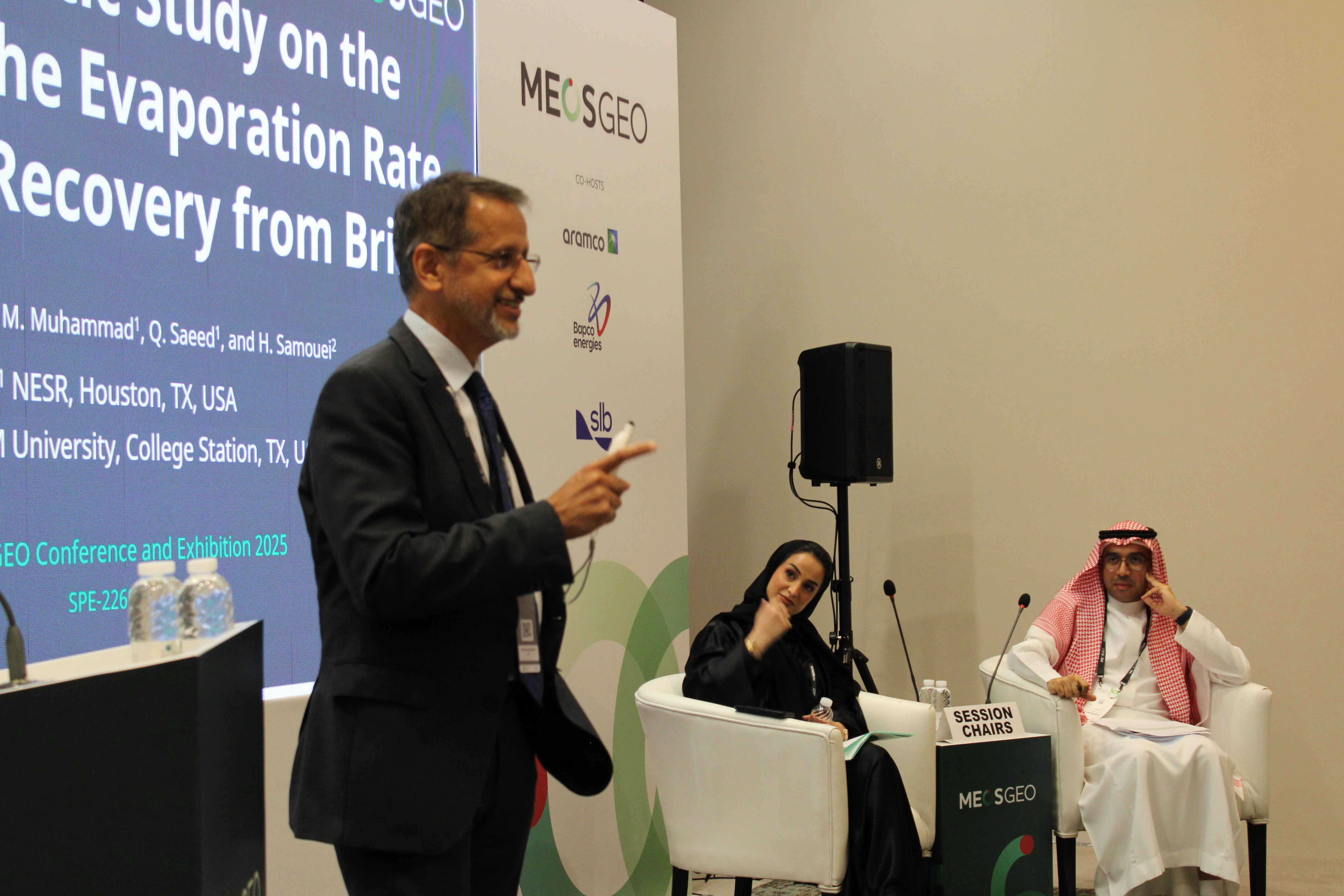
A presenter at MEOS GEO 2027

Why submit a proposal?

  • Share your work with a global audience of industry and academic peers
  • Contribute to advancing technical knowledge across the upstream value chain
  • Present alongside respected experts from across the sector
  • Support collaboration between industry, academia, and emerging talent
  • Upon submission and acceptance of an abstract to the MEOS GEO 2027 Technical Programme, you are automatically entered into a chance to win one of the Technical Programme Awards, in which the top 3 candidates in the following categories will be rewarded:
    • Recovery
    • Discovery
    • Sustainability
    • AI & digitalisation
    • Young professional
    • Academia
    • Impact & inclusion
  • Gain the opportunity to have your work featured in leading global industry journals

MEOS GEO 2027 TECHNICAL PROGRAMME

Technical topics

All proposals, manuscripts, and presentations must be in English, as it is the official language for SPE conferences and publications. Submissions in any other language will not be accepted. 

The MEOS GEO Technical Programme is managed by SPE. SPE must comply with all applicable sanctions laws, including those of the United States and the United Kingdom. This includes screening individuals and entities against applicable lists of restricted parties to determine whether SPE is prohibited from, among other things, providing services to or receiving services from such parties. 

As a result, your proposal will go through a compliance review, and if identified one or more authors or the entity they represent is listed on the SDN sanctions list, we must regretfully inform you that your paper will not be considered in forming the conference programme. 

We appreciate your submission and your understanding of MEOS GEO legal compliance criteria.

1.1 Artificial Intelligence and Machine Learning 

1.2 Digital Twins and Simulation 

1.3 IoT and Smart Devices in Energy 

1.4 Data Platforms and High-Performance Computing 

1.5 Cybersecurity in Energy Industry 

1.6 Smart Grid 

1.7 Cloud Computing 

1.8 Real-Time Data Analytics, Monitoring, Validation, and Reconciliation 

1.9 Robotics and Autonomous Systems 

1.10 Data Augmentation, Augmented Reality, and Virtual Reality 

1.11 Applications in Quantum and Edge Computing 

1.12 Generative AI and Foundation Models 

1.13 Agentic AI and Autonomous Workflows 

1.14 Scientific and Physics-Informed AI

 1.15 AI Applications in Industry: Regulation and Governance 

1.16 Space Technologies and Earth Observation

    2.1 Advancements in Drill Bit Technology 

    2.2 Drilling Fluids and Hydraulics 

    2.3 Wellbore Stability Modelling and Optimisation 

    2.4 Wellbore Strengthening and Lost Circulation Mitigation

    2.5 Directional Drilling and Wellbore Placement 

    2.6 Well Integrity and Cementing 

    2.7 Stuck Pipe Prevention and Mitigation 

    2.8 Managed Pressure Drilling and Annular Pressure Drilling 

    2.9 Underbalanced Drilling 

    2.10 High-Pressure High-Temperature Drilling 

    2.11 Well Design Optimisation 

    2.12 Drilling Operation Optimisation 

    2.13 Autonomous and AI-Assisted Drilling

    2.14 Advancements in Coiled-Tubing Drilling Applications 

    2.15 Wellhead Design and Configuration 

    2.16 Environmental and Safety Considerations in Drilling 

    2.17 Drilling Measurements, Logging and Telemetry 

    2.18 Geosteering and Reservoir Navigation

      3.1 Well Completion 

      3.2 Intelligent Completions and Smart Wells 

      3.3 Artificial Lift Technologies 

      3.4 Production Data Analytics 

      3.5 Production Optimisation 

      3.6 Flow Measurement and Production Allocation 

      3.7 Well Stimulation, Intervention and Cleanout 

      3.8 Hydraulic Fracturing 

      3.9 Flow Assurance and Pipeline Management 

      3.10 Environmental and Safety Practices in Production 

      3.11 Completion and Production Monitoring 

      3.12 Sour Gas and H2S Control 

      3.13 Scale and Corrosion Monitoring

        4.1 Reservoir Characterisation

        4.2 Advances in Petrophysics and Rock Physics 

        4.3 Formation Evaluation 

        4.4 Well Testing and Analysis 

        4.5 PVT and Phase Behaviour 

        4.6 Advances in Reservoir Surveillance 

        4.7 Fracture and Geomechanics 

        4.8 Production Enhancement Techniques 

        4.9 Integrated Reservoir Simulation and Modelling 

        4.10 Reservoir Management and Optimisation

        4.11 Waterflooding Optimisation 

        4.12 Enhanced Oil Recovery 

        4.13 Uncertainty and Risk Analysis 

        4.14 Field Development Case Studies 

        4.15 Digital Reservoir Engineering

          5.1 Advancements in Seismic Processing and Imaging 

          5.2 High-Performance Computing for Geoscience Applications 

          5.3 Geophysical Methods for Reservoir Characterisation

          5.4 Inversion and Forward Modelling 

          5.5 Near-Surface Geophysics 

          5.6 Advances in Petrophysics and Rock Physics 

          5.7 Marine Geophysics 

          5.8 Non-Seismic Geophysical Methods 

          5.9 Geophysical Monitoring 

          5.10 Geophysical Data Acquisition 

          5.11 Seismic Stratigraphy and Interpretation

            6.1 Portfolio Risking and Ranking Methods 

            6.2 Volumetric Assessments Best Practices 

            6.3 Basin Modelling 

            6.4 Structural Geology 

            6.5 Fault Seal Analysis 

            6.6 Geomechanics Applications 

            6.7 Reservoir Characterisation and Modelling 

            6.8 Outcrops and Analogues in Geological Studies 

            6.9 Geochemical Analysis and Applications 

            6.10 Exploration Frontiers and Case Studies 

            6.11 Sedimentology and Stratigraphy 

            6.12 Forward Stratigraphic Modelling 

            6.13 Formation Evaluation and Petrophysics 

            6.14 Hydrology and Hydrogeology 

            6.15 Reservoir Diagenesis

              7.1 Global and Emerging Unconventional Plays 

              7.2 Shale and Tight Reservoir Exploration and Sweetspotting 

              7.3 Unconventional Fields Development and Planning 

              7.4 Micro-Scale Characterisation of Mudrock and Tight Reservoirs 

              7.5 Fluid Characterisation for Unconventional Reservoirs 

              7.6 Geomechanics of Shale and Tight Reservoirs 

              7.7 Geoscience Integration for Assessing Stimulated Rock Volume 

              7.8 Unconventional Field Development Case Studies

                8.1 Integrated Field Development Case Studies 

                8.2 Mature Field Development and Management 

                8.3 Gas Reservoirs Development 

                8.4 Integrated Asset Development 

                8.5 Exploration-to-Production Workflows 

                8.6 Cross-Disciplinary Decision Making

                  9.1 Hydrogen 

                  9.2 Geothermal Energy 

                  9.3 Renewable Energy 

                  9.4 Low-Carbon Technologies 

                  9.5 Energy Storage 

                  9.6 Materials and Minerals for Renewable Energy 

                  9.7 Mining of Strategic Minerals from Brines 

                  9.8 Mineral Prospectivity Mapping and Data Processing

                    10.1 CO2 Enhanced Hydrocarbon Recovery 

                    10.2 CO2 Mineralisation 

                    10.3 Integrated Subsurface Technologies for CCUS 

                    10.4 Carbon Storage Modelling 

                    10.5 CO2 Monitoring and Risk Mitigation 

                    10.6 Geomechanics for CCUS 

                    10.7 CCUS Screening and Site Evaluation 

                    10.8 Policy and Regulatory Frameworks for CCUS

                      11.1 Produced Water Treatment 

                      11.2 Produced Water Reuse 

                      11.3 Produced Water Injection 

                      11.4 Industrial Water Treatment and Management 

                      11.5 Forever Chemicals (PFAS), Water Contamination, and Purification

                        12.1 Technology Development and Readiness 

                        12.2 Innovation Management 

                        12.3 Technology Deployment and Scale-Up 

                        12.4 Technology Commercialisation and Value Realisation 

                        12.5 Startup and Industry Collaboration

                          13.1 Drilling and Cement Chemistry 

                          13.2 Chemical Enhanced Oil Recovery 

                          13.3 Scale and Corrosion Inhibitors and Dissolvers 

                          13.4 Stimulation and Production Chemicals for Flow Assurance 

                          13.5 Chemical Water Control 

                          13.6 Chemical Solutions for Sand Control 

                          13.7 Foaming Agents 

                          13.8 Green Chemistry in Oilfield Operations 

                          13.9 Nanotechnology 

                          13.10 Computational Chemistry 

                          13.11 Encapsulation and Coating Material Technologies 

                          13.12 Corrosion Resistance Materials 

                          13.13 Non-Metallic and Composite Materials for Oil and Gas Applications 

                          13.14 Bio-Based and Biodegradable Oilfield Chemicals 

                          13.15 Chemical Demulsification and Emulsion Chemistry 

                            14.1 Talent Development 

                            14.2 Leadership in Energy 

                            14.3 Upskilling and Reskilling 

                            14.4 Digital Skills and AI Literacy 

                            14.5 Knowledge Management 

                            14.6 University–Industry Partnerships 

                            14.7 Technical Competency Development

                              15.1 Lifecycle Assessment of Energy Production Systems 

                              15.2 Environmental Impact Mitigation 

                              15.3 Health and Safety Innovations 

                              15.4 Risk Assessment and Management 

                              15.5 Sustainable Development Practices 

                              15.6 Circular Economy 

                              15.7 Regulatory Compliance and Best Practices 

                              15.8 Environmental, Social and Governance (ESG) 

                              15.9 Operational Excellence

                                Additional resources

                                Proposal information 

                                Please note that abstract submissions should be formatted into four (4) specific paragraphs:

                                1. Objectives/scope: Please list the objectives and/or scope of the proposed paper. (25-75 words) 
                                2. Methods, procedures, process: Briefly explain your overall approach, including your methods, procedures and process. (75-100 words) 
                                3. Results, observations, conclusions: Please describe the results, observations and conclusions of the proposed paper. (100-200 words) 
                                4. Novel/additive information: Please explain how this paper will present novel (new) or additive information to the existing body of literature that can be of benefit to and/or add to the state of knowledge in the petroleum industry. (25-75 words) 

                                The following guidelines apply:

                                • DO NOT include title or author information in your proposal
                                • Word Minimum: 225 
                                • Word Maximum: 450 

                                General guidelines

                                • If the proposal is accepted, authors will have the option to submit either:
                                  • A full manuscript (4,000–7,000 words)
                                  • An extended abstract (2,000–4,000 words)
                                  • A presentation only
                                • Obtain the necessary clearance from your management, your partners, and customers BEFORE submission .
                                • Authors whose proposals are accepted and have opted to submit a manuscript/extended abstract, will be required to complete the manuscript/extended abstract submission by Tuesday, 22 June 2027, for inclusion in the conference proceedings.
                                • An agreement to present a paper at this SPE conference carries an obligation to participate in the event. Please review SPE's Author Guidelines for Papers.

                                A word on commercialism

                                SPE has a stated policy against the use of commercial trade names, company logos, or text that is commercial in tone in the paper title, text, or presentation slides. Use of such terms will result in careful scrutiny by the Programme Committee in the evaluation of paper proposals, and the presence of commercialism in the paper will result in it being withdrawn from the programme.

                                Plagiarism check

                                In an effort to further improve SPE’s technical quality standards, all submitted papers will be checked for plagiarism.

                                Company approval

                                It is the responsibility of the author to obtain company clearance to ensure the company understands that if the proposal is accepted, you will be required to travel to the event to present. All travel expenses (airfare, hotel, registration) associated with attending the conference are the responsibility of the company or individual attending.

                                Author resources

                                If you are interested in writing a paper, SPE has a variety of resources to help you contribute to the knowledge and future of the upstream oil and gas industry.